
Today’s post is more of an update than anything else. With HPD evolving more and more into an agency/standalone service business and less of a “make money online” blog, I think it’s prudent to give some updates and insights into our systems.
Scaling A Business Is Hard
It’s hard, but infinitely rewarding at the same time.
What I’ve found to be the hardest isn’t the actual customer acquisition part (at least not in 2015), but more the ability to keep up with demand.
Every day we get dozens of new people signing up for the early-bird notification list, and rarely a day goes by that somebody doesn’t email me asking about a site.
This is great! The business is growing, people are digging what we’re doing, and most importantly, we have a constant flow of income coming in that allows us to re-invest in the business.
Sounds like a 24/hour party right?
Well, it sure is a 24/hour business, but it’s a long way from being a party. The hardest part about scaling is that you naturally create your own problems as well.
Things like:
- Not being able to meet demand/increased turnaround times.
- Hiring more staff = more time spent training.
- More staff = higher chance of ‘poor work’ being created.
- The more customers you have, the less time to get more customers you have (oh the irony!).
Gael Breton said it best in this post:
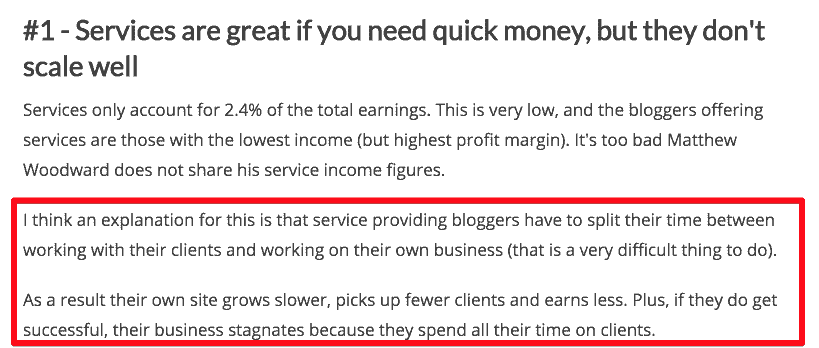
Well, we have managed to scale pretty well, but Gael was totally correct (he’s always been an insightful guy). It’s hard, and when you find yourself spending time working with the clients and not on the business, it can get frustrating.
As such, it’s been an interesting few months as I’ve literally learned from scratch how to build a team, create systems, and make things happen.
Communication With Buyers Has Suffered
One of the things that I am least proud of is that communication to buyers has suffered. Inititally I thought the most important thing was to get sites finished as soon as possible, but I’ve learned over the last couple of months that this is wrong.
Generally, customers are happy to wait as long as two things happen:
- They know in advance how long it will take
- They get regular updates.
If I was saying in the past that a site would take two weeks, only for it to take three, that was a major problem. From now on, I’ll say three to four weeks. At least this gives us leeway for things like writers getting held up or other site construction delays.
On top of that, starting from tomorrow (Friday 14th), we’ll be giving weekly updates to customers whose sites are in the works. If this applies to you, you can expect an email from me tomorrow.
Taking the initiative and updating people is very important I’ve learned. It’s much better for a customer to see a message in their inbox than to have to send one to me asking for an update.
Managing Things Better On Our Own End
For this part, I thought I’d give you guys some insights into how we manage our systems.
For most of the year, it’s just been a simple spreadsheet with Google Drive. Yep, that simple!
The spreadsheet has a lot of data in there, such as the customer name, the domain, the process of construction, the name of the writer doing the content, and a bunch of other tabs.
This worked fine when it was just me and a couple of others involved, and a handful of customers a month. Right now though, we’re building anywhere from 20-40 sites a month, and spreadsheets are proving not to be the most efficient systems.
Despite the fact that they work fine for all intensive purposes, there are some issues with using them, and not only that, it’s cumbersome to set yourself reminders, and you can end up forgetting to notify customers or follow-up with writers.
Plus, they just don’t look that cool.
The solution: Basecamp
After trying things like Trello, and looking into Zendesk, we decided to go with Basecamp as our project management tool.
The reason I went with Basecamp was because I loved the interface, and the To Do list structure. We could also create templates.
Now, whenever a new site sale is made, we can use a template to create a new project, set ourselves some reminders to update customers and follow-up on writers. Here’s a snapshot below:
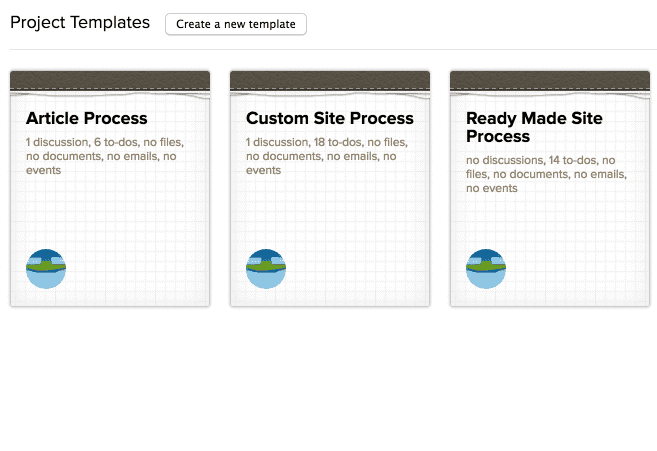
This screenshot shows how we’ve created three templates, one for each of our services.
The shot below is a snippet from our “Custom Site Process” to do list:
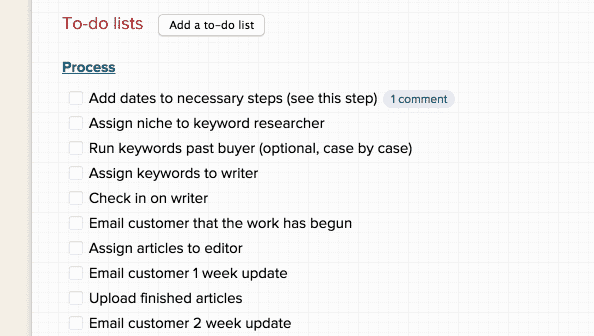
What’s great about this is that we can track our own progress very easily, but by setting reminders and adding physical dates to them, we also stay on top of customer communication. Dates get added to our calendars and these can sync with our inboxes, to make sure we don’t miss any steps.
Pretty cool right? I’m looking forward to putting it to work with the next batch of sites.
Stumbling Along
To conclude, I just wanted to highlight that HPD is definitely going through a process of changing and growing, and sometimes we do find ourselves stumbling along!
What’s most important is that while our timing and our communication may have suffered, the quality has always been consistent.
Bear with us while we grow and expand, and hopefully, get smoother!
